One of the most fundamental questions early childhood educators must ask themselves is, “How does learning happen?” If our school systems are ever going to go beyond their current practices of giving and regurgitating information, we need to understand deeply how learning occurs.
What was happening on an occasion where you would say you learned a lot?
What learnings have you most deeply remembered and integrated into your life?
How do you believe learning happens?
Only as we answer those fundamental questions will we be able to teach and learn differently. As we reflect individually, through study, and with our colleagues, we deepen our understanding of ways to support children’s learning.
Social Constructivist Theory
Our Neighborhood believes in social constructivism. Simply that children learn best in the context of secure social relationships, and they construct knowledge through play. We believe that learning happens when children are engaged with others in play. While this seems fairly simple, this is a rather new articulation of how learning happens. Our Neighborhood rejects the old model of teachers being the all knowing givers of information, and sees children as the drivers of their own learning. Children drive their play, engaging with others, both peers and adults, and revise their theories through engagement with new ideas and information.

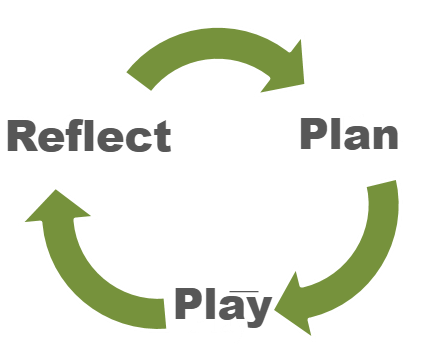
We believe in a model of learning that places children, the learner, in the center of the cycle, and sees learning in each part of the process. It is through play that new knowledge is constructed, integrated, and remembered. If play is poorly planned, it is unlikely to result in deep learning. After play, we reflect through documentation, discussion, and wait time. It is in reflection that learning is integrated with other ideas and challenged. This reflection drives the planning of deeper and increasingly more complex play, through which more knowledge is constructed. In planning, we gather hypotheses, questions, and resources. After planning we return again to play.